So Lawrence Lipking wrote this really funny essay about many Frankenstein-related things, most specifically the consensus among readers and teachers about the text that exists simultaneously with completely polarized opinions of the novel and its meaning. Various didactic methods are also explored in general, in relation to the text, and in accordance with Rousseau's Emile. Actually, he talks about Rousseau a lot.
*Lipking's all like "there is no one way to interpret Frankenstein! And that's the beauty of it!" "Just kidding! I'm going to subscribe to the methodology I indict and tell you about one particular way of reading it!" At least he's self aware.
*Turns out the reading of Frankenstein Lipking suggests is one that draws much from the work of Genevan philosopher Jean Jacques Rousseau, who essentially says that nature is good and all that nature creates is good, but man and society corrupt. Also his book Emile is about teaching, and Shelley's own shortcomings as a student (she never had a tutor, and, much like Walton, was largely self-taught. She found in her husband the much-needed tutor that Walton found in Victor. Emile is about the necessity of treating pupils like humans, not children or buckets into which "knowledge" can simply be poured. The importance of proper education is such that lacking it can lead to ruin (as it did with Victor, who claims that "It is even possible, that the train of my ideas would never have received the fatal impulse that led to my ruin." - because he had access to the likes of Cornelius Agrippa and a thirst for knowledge, but alas no instructor in the modern sciences, he became obsessed with an undertaking which might have been avoided))
Tuesday, November 1, 2011

Sunday, October 2, 2011
Gawain and Cincinnatus: BEST BUDDIES (if they lived in the same century)
In Livy's Ab Urbe Condita, the revered historian of Rome recounts the story of retired consul Cincinnatus: In a battle against the Sabines and the Aequians, much of the Roman army had been trapped in the Alban Hills and were attempting to fight off a siege. As often they do in desperate times of war, the senate allowed the consul to choose a dictator, to whom absolute power over Rome, her senate, and her army would be granted. Cincinnatus, as the story goes, was plowing his fields one day when a group of senators came to him bearing news that the consul had nominated him to be Rome's dictator. Cincinnatus threw down his plow, had his wife bring him his senatorial toga, and returned to Rome. The following day, he called for every man of military age to report to the Campus Martius, and with Rome's finest soldier as his second-in-command, he led his newly-assembled army to the hills, where the battle was easily won. The Aequians begged for mercy, and wanting to avoid unnecessary bloodshed, Cincinnatus let them live so long as they submitted to him. Victorious, Cincinnatus returned to Rome and gave up his dictatorship, returning to his fields 16 days after he had left.
The truth of the story of Cincinnatus, along with many of Livy's other stories, is questionable, but in this highly-romanticized tale (for it is only that, a tale, as Ab Urbe Condita was commissioned by Emperor Augustus to boost morale and public support, so much of its content could very well be gross exaggeration), the reality of the man and his story do not matter. What Livy's Cincinnatus gives us is a portrait of an ideal leader: a man that is stronger than the absolute power that tempts him, revered enough to be chosen for a daunting task, skilled enough to succeed in this undertaking, yet humble enough to act only in the best interest of his country and return to a modest life after grand victory. Livy created a character perfectly sound in mind and body, worth of the respect of all who may come in contact with his story, to whom any Roman may aspire the same way the "Gawain" poet created a character whose values and abilities any Middle English reader could strive towards.
In"Sir Gawain and the Green Knight," Gawain is the epitome of bravery, chivalry, honor, and all that is good in a knight. He values his duty to Arthur and the Round Table over his own life, accepting what seems to be a suicide mission and, more importantly, carrying it out until the end. Despite the temptation of a conniving woman, despite the opportunity to flee his undertaking and imminent death, Gawain time and time again proved his worth and his steadfastness, succumbing not to whatever easy solution he was presented. Despite praise and scores of people encouraging him, Gawain remains modest about his position, never boasting. Like Cincinnatus, Gawain epitomizes perfection in the eyes of his audience.
The truth of the story of Cincinnatus, along with many of Livy's other stories, is questionable, but in this highly-romanticized tale (for it is only that, a tale, as Ab Urbe Condita was commissioned by Emperor Augustus to boost morale and public support, so much of its content could very well be gross exaggeration), the reality of the man and his story do not matter. What Livy's Cincinnatus gives us is a portrait of an ideal leader: a man that is stronger than the absolute power that tempts him, revered enough to be chosen for a daunting task, skilled enough to succeed in this undertaking, yet humble enough to act only in the best interest of his country and return to a modest life after grand victory. Livy created a character perfectly sound in mind and body, worth of the respect of all who may come in contact with his story, to whom any Roman may aspire the same way the "Gawain" poet created a character whose values and abilities any Middle English reader could strive towards.
In"Sir Gawain and the Green Knight," Gawain is the epitome of bravery, chivalry, honor, and all that is good in a knight. He values his duty to Arthur and the Round Table over his own life, accepting what seems to be a suicide mission and, more importantly, carrying it out until the end. Despite the temptation of a conniving woman, despite the opportunity to flee his undertaking and imminent death, Gawain time and time again proved his worth and his steadfastness, succumbing not to whatever easy solution he was presented. Despite praise and scores of people encouraging him, Gawain remains modest about his position, never boasting. Like Cincinnatus, Gawain epitomizes perfection in the eyes of his audience.
Thursday, September 22, 2011
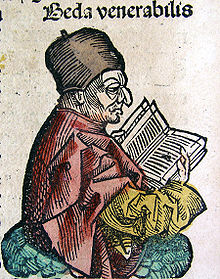
The Life and Times of St. Bede the Venerable
The, as the name implies, highly revered monk St. Venerable Bede was a Roman Catholic English monk in the late 7th Century and early 8th Century. He was born and died in the town of Jarrow in the Kingdom of Northumbria, which is now northern England and southeast Scotland. Most of what is known about our well-respected Bede is from a short autobiographical blurb at the end of his work the Ecclesiastical History of the English People, for which he is most commonly remembered. Good 'ol Bede joined the monastery at the age of seven, and by the age of 30 he was a priest at his home of the monasteries of Monkwearmouth and Jarrow. From that point until his death at age 63, Bede was a prolific writer and scribe, with most of his work consisting of three major categories, science, history, and theological. His scientific manuscripts consisted of studies of grammar, natural phenomena, and the calendar. His theological studies were broad and numerous as well, but Bede is best known for his comprehensive history of the English language, which earned him the epithet "Father of English History."
Bede was writing up until his death, composed a poem on his deathbed that is now the most copied old English poem. Although granted sainthood and venerated post-mortem, the origins of his "Venerable" name are unknown and unrelated to those two other designations.
Bede was writing up until his death, composed a poem on his deathbed that is now the most copied old English poem. Although granted sainthood and venerated post-mortem, the origins of his "Venerable" name are unknown and unrelated to those two other designations.
Tuesday, August 30, 2011
My Problem with Anthony Burgess's A Clockwork Orange...
I am not very cinematically cultured. If I had a penny for every time someone asked me, "Have you seen [movie X]? What? No? You haven't? But it's classic!", I'd be a very rich girl indeed. And more times than I can count, "movie X" has been A Clockwork Orange. More times than I can count, I've heard about what a beautiful piece of film it is, how gripping and thrilling and moving, how many perspectives it has changed and how many minds it has both baffled and scarred. "Oh, and the book." "It's my favorite." “The things it does with language. It’s just magical.”
So, with extremely high expectations, I picked up a copy of the trim little paperback, curled up into a ball, and prepared myself for a mindblowing experience. But in the first few pages, my mind was just confused. The “Nadsat” slang with Slavic roots used in the novel was confusing and unnecessary, and even though the difficulty of interpreting the foreign words rapidly faded as the book wore on, it never lost the feeling of irrelevance. The only point at which I felt Nadsat was truly necessary and had any meaning whatsoever despite the painfully obvious need to differentiate the young and “ultraviolent” Nadsat from their older victims was when the slang language was used exclusively in descriptions of particularly gory, violent acts. Then, the foreign words conveyed their meaning adequately, but the true horror of the actions they described was dulled by unfamiliar words. Burgess, in his introduction, addressed this as well, explaining that Nadsat’s primary use was to dull the blows of the shockingly violent actions of those speaking it, similar to the mindset employed by Nadsat speakers to muffle the emotional response that their horrible acts should have elicited.
Which brings me to my second problem with A Clockwork Orange. The reader is never given the opportunity to come to realizations such as the true point of the Nadsat tongue on their own. Any meaning beyond what is superficially obvious is either told to the reader in the author’s introduction (he too, I might add, was not entirely satisfied with the novel, though for reasons that differ from my own), or explicitly stated in the text itself. The grand underlying theme of the novel—that a person’s humanness is based on their ability to make rational choices, and once that ability to make moral choices is taken away, humanness is taken away with it—which is easy enough to uncover and ponder and could potentially be extremely interesting and complex and subtle simply is not because rather than allow the reader to come to some profound realization unaided, Burgess instead has a wise prison reverend state a simplified version blatantly to the main character. Any joy that might have come from that moment of epiphany when the purpose of the novel, what everything means, snaps into clarity, is stripped from the book by having it be spoonfed to the reader.
Really, those are my only two problems with A Clockwork Orange. Beyond these two, I found it be interesting and, for the most part, compelling. Subtlety, however, was lacking, and for me, subtlety is a must.
Friday, August 26, 2011
Books that have stuck with me over time, in no particular order....
You might notice that most of these books are children's books, or that many of them are "firsts." This isn't because I stopped reading good books after childhood, but because for me, the first of a certain type of book was the baseline, compared to every other and therefore the most memorable. Like eating an apple, the first bite is always the best. Also these are definitely not necessarily my favorite books, again, just the most memorable.
1) Gravity's Rainbow, Thomas Pynchon
I'm starting this list off with Gravity's Rainbow for two reasons: one, I read it relatively recently so it was the first truly impressive work that came to mind, and two, because it blew my mind. Really, truly blew my mind. To shreds. Like a bazooka to a helium balloon. I felt as though I was perpetually scratching away at the tip of an iceberg with a glacier of dense, wordy, witty brilliance extending below my feet. That is, until a few rare glimpses of clarity, when the full force of the work would slap me upside the head and snap everything into focus. I will probably reread that book a dozen times and still not even be close to fully grasping all that Pynchon crunched into it. Really, seriously impressive work.
2) Of Mice and Men, John Steinbeck
Of Mice and Men has been a favorite book of mine since I read it at age 13. I've never been as emotionally distraught after finishing a book as I was after George shot Lenny (spoiler alert!), for some reason I just became completely attached to the characters, sympathetic of their situations and understanding of their decisions, heartbreaking as those decisions might have been.
3) Life of Pi, Yann Martel
Read it when I was 9 and then never again, and it's still one of the only books I'm able to recall almost entirely. I usually have a lot of difficulty remembering details of books, regardless of how much I loved them or how recently I've read them, but every trivial detail of Life of Pi has stuck with me over the 8 year gap since my last reading. The passage where he snaps the turtle's neck, remembering how he was once reluctant to snap a banana open, imagining it to be an animal's neck? Golden.
4) Charlie and the Chocolate Factory, Roald Dahl
My first of the many Dahl books that filled my childhood, Charlie and the Chocolate Factory always stuck out as a best and a favorite, with Dahl's autobiography as a close second. I can't even begin to guess how many times I read this book, and each re-reading delivers the same dose of whimsical Dahl-goodness.
5) The Secret Garden, Frances Burnett
First chapter book I ever read, and it was interesting to me because the character with whom I associated the most was the garden itself rather than any of the people. Since it was my first long-ish book, the experience of reading it will always be memorable for me.
7) Redwall and Mattimeo, Brian Jacques
The TV show on PBS made me really happy, and being a slightly pretentious bookworm child, I was ecstatic when I found out it was based on a book series.
8) Assorted Short Stories: (I love short stories. Good things come in little packages)
"Jonathan Livingston Seagull"
Hated this when we were supposed to read it in 7th grade, but now I really love it. Jonathan when he's plummeting into the ocean and nearly dies gets me every time.
"A Perfect Day for Bananafish"
Like Of Mice and Men, let me empty and emotionally shaken (but to nowhere near the same degree).
"The Ones Who Walk Away from Omelas"
"They're Made Out of Meat"
Not necessarily my favorite story, but really thought provoking and clever. This is one of those stories that you think about at some level on a daily basis
1) Gravity's Rainbow, Thomas Pynchon
I'm starting this list off with Gravity's Rainbow for two reasons: one, I read it relatively recently so it was the first truly impressive work that came to mind, and two, because it blew my mind. Really, truly blew my mind. To shreds. Like a bazooka to a helium balloon. I felt as though I was perpetually scratching away at the tip of an iceberg with a glacier of dense, wordy, witty brilliance extending below my feet. That is, until a few rare glimpses of clarity, when the full force of the work would slap me upside the head and snap everything into focus. I will probably reread that book a dozen times and still not even be close to fully grasping all that Pynchon crunched into it. Really, seriously impressive work.
2) Of Mice and Men, John Steinbeck
Of Mice and Men has been a favorite book of mine since I read it at age 13. I've never been as emotionally distraught after finishing a book as I was after George shot Lenny (spoiler alert!), for some reason I just became completely attached to the characters, sympathetic of their situations and understanding of their decisions, heartbreaking as those decisions might have been.
3) Life of Pi, Yann Martel
Read it when I was 9 and then never again, and it's still one of the only books I'm able to recall almost entirely. I usually have a lot of difficulty remembering details of books, regardless of how much I loved them or how recently I've read them, but every trivial detail of Life of Pi has stuck with me over the 8 year gap since my last reading. The passage where he snaps the turtle's neck, remembering how he was once reluctant to snap a banana open, imagining it to be an animal's neck? Golden.
4) Charlie and the Chocolate Factory, Roald Dahl
My first of the many Dahl books that filled my childhood, Charlie and the Chocolate Factory always stuck out as a best and a favorite, with Dahl's autobiography as a close second. I can't even begin to guess how many times I read this book, and each re-reading delivers the same dose of whimsical Dahl-goodness.
5) The Secret Garden, Frances Burnett
First chapter book I ever read, and it was interesting to me because the character with whom I associated the most was the garden itself rather than any of the people. Since it was my first long-ish book, the experience of reading it will always be memorable for me.
7) Redwall and Mattimeo, Brian Jacques
The TV show on PBS made me really happy, and being a slightly pretentious bookworm child, I was ecstatic when I found out it was based on a book series.
8) Assorted Short Stories: (I love short stories. Good things come in little packages)
"Jonathan Livingston Seagull"
Hated this when we were supposed to read it in 7th grade, but now I really love it. Jonathan when he's plummeting into the ocean and nearly dies gets me every time.
"A Perfect Day for Bananafish"
Like Of Mice and Men, let me empty and emotionally shaken (but to nowhere near the same degree).
"The Ones Who Walk Away from Omelas"
"They're Made Out of Meat"
Not necessarily my favorite story, but really thought provoking and clever. This is one of those stories that you think about at some level on a daily basis
Thursday, August 25, 2011
Another thing that got forgotten was the fact that against all probability a sperm whale had suddenly been called into existence several miles above the surface of an alien planet.
And since this not a naturally tenable position for a whale, this poor innocent creature had very little time to come to terms with its identity as a whale before it then had to come to terms with not being a whale any more.
This is a complete record from the moment it began its life to the moment it ended it.
Ah...! What's happening? it thought.
Er, excuse me, who am I?
Why am I here? What's my purpose in life?
What do I mean by who am I?
Calm down, get a grip now...Oh, this is an interesting sensation, what is it? It's a sort of...yawning, tingling sensation in my...my...well I suppose I'd better start finding names for things if I want to make any headway in what for the sake of what I shall call an argument I shall call the world, so let's call it my stomach.
Good. Ooooh, it's getting quite strong. And hey, what about this whistling roaring sound going past what I'm suddenly going to call my head? Perhaps I can call that...wind! Is it a good name? It'll do...perhaps I can find a better name for it when I've found out what it's for. It must be something very important because there certainly seems to be a hell of a lot of it. Hey! What's this thing? This...let's call it a tale--yeah, tale. Hey! I can really thrash it about pretty good, can't I? Wow! Wow! That feels great! Doesn't seem to achieve very much but I'll probably find out what it's for later on. Now, have I built up any coherent picture of things yet?
No.
Never mind, hey, this is really exciting, so much to find out, so much to look forward to, I'm quite dizzy with anticipation....
Or is it the wind?
There really is a lot of that now, isn't there?
And wow! Hey! What's this thing suddenly coming toward me very fast? Very, very fast. So big and flat and round, it need a big wide-sounding name like...ow...ound...round...ground! That's a good name--ground!
I wonder if it will be friends with me?
And the rest, after a sudden wet thud, was silence.
-Douglas Adams, The Hitchhiker's Guide to the Galaxy
The above passage from The Hitchhiker's Guide to the Galaxy (from now on, HHGTTG, because my fingers beg for mercy), does not really illustrate excellent storytelling. In fact, the five-book "trilogy" of which this first titular volume is a part lacks what most would consider to be traits of "good storytelling," such as some sort of profound social commentary, revelation of a universal truth or of a characteristic of human nature, or even the seemingly-necessary convention of plot. Granted, HHGTTG was initially a BBC radio broadcast, which accounts for its light and casual nature, and the collection of novels were adapted from radio and a plethora of other media, contributing to the utter lack of plot consistency or even sense. But somehow, despite the novels' shortcomings in the sanity area, they're still considered classic (in some circles) and still enjoyed by many. That's where the quoted passage above comes in. It's not quoted because it immerses the reader in a rich and vivid scene, because its characters are particularly relatable (though the existential crisis sperm whale is in a place where really all of us have been at some point, without a doubt), or because it conveys some deep and grandiose message that the reader can reflect upon later or post as a Facebook status to impress their friends. It's quoted because it's hilarious. Like the rest of the books, the combination of ridiculousness, improbability, and that oh-so-lovable dry Brit wit dangling loosely from the already loose plot lines are what make HHGTTG a good story. By the end of the five novels, story lines have been thrown about and abruptly ended and characters have been forgotten, but the book is closed with a smile because, hey, that was an enjoyable read. That's what good storytelling is to me, something that will brighten my day just a little bit, even at the expense of a sperm whale or two.
And since this not a naturally tenable position for a whale, this poor innocent creature had very little time to come to terms with its identity as a whale before it then had to come to terms with not being a whale any more.
This is a complete record from the moment it began its life to the moment it ended it.
Ah...! What's happening? it thought.
Er, excuse me, who am I?
Why am I here? What's my purpose in life?
What do I mean by who am I?
Calm down, get a grip now...Oh, this is an interesting sensation, what is it? It's a sort of...yawning, tingling sensation in my...my...well I suppose I'd better start finding names for things if I want to make any headway in what for the sake of what I shall call an argument I shall call the world, so let's call it my stomach.
Good. Ooooh, it's getting quite strong. And hey, what about this whistling roaring sound going past what I'm suddenly going to call my head? Perhaps I can call that...wind! Is it a good name? It'll do...perhaps I can find a better name for it when I've found out what it's for. It must be something very important because there certainly seems to be a hell of a lot of it. Hey! What's this thing? This...let's call it a tale--yeah, tale. Hey! I can really thrash it about pretty good, can't I? Wow! Wow! That feels great! Doesn't seem to achieve very much but I'll probably find out what it's for later on. Now, have I built up any coherent picture of things yet?
No.
Never mind, hey, this is really exciting, so much to find out, so much to look forward to, I'm quite dizzy with anticipation....
Or is it the wind?
There really is a lot of that now, isn't there?
And wow! Hey! What's this thing suddenly coming toward me very fast? Very, very fast. So big and flat and round, it need a big wide-sounding name like...ow...ound...round...ground! That's a good name--ground!
I wonder if it will be friends with me?
And the rest, after a sudden wet thud, was silence.
-Douglas Adams, The Hitchhiker's Guide to the Galaxy
The above passage from The Hitchhiker's Guide to the Galaxy (from now on, HHGTTG, because my fingers beg for mercy), does not really illustrate excellent storytelling. In fact, the five-book "trilogy" of which this first titular volume is a part lacks what most would consider to be traits of "good storytelling," such as some sort of profound social commentary, revelation of a universal truth or of a characteristic of human nature, or even the seemingly-necessary convention of plot. Granted, HHGTTG was initially a BBC radio broadcast, which accounts for its light and casual nature, and the collection of novels were adapted from radio and a plethora of other media, contributing to the utter lack of plot consistency or even sense. But somehow, despite the novels' shortcomings in the sanity area, they're still considered classic (in some circles) and still enjoyed by many. That's where the quoted passage above comes in. It's not quoted because it immerses the reader in a rich and vivid scene, because its characters are particularly relatable (though the existential crisis sperm whale is in a place where really all of us have been at some point, without a doubt), or because it conveys some deep and grandiose message that the reader can reflect upon later or post as a Facebook status to impress their friends. It's quoted because it's hilarious. Like the rest of the books, the combination of ridiculousness, improbability, and that oh-so-lovable dry Brit wit dangling loosely from the already loose plot lines are what make HHGTTG a good story. By the end of the five novels, story lines have been thrown about and abruptly ended and characters have been forgotten, but the book is closed with a smile because, hey, that was an enjoyable read. That's what good storytelling is to me, something that will brighten my day just a little bit, even at the expense of a sperm whale or two.
Subscribe to:
Posts (Atom)