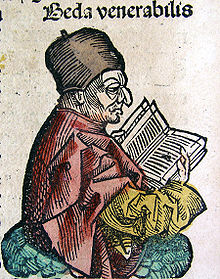
The, as the name implies, highly revered monk St. Venerable Bede was a Roman Catholic English monk in the late 7th Century and early 8th Century. He was born and died in the town of Jarrow in the Kingdom of Northumbria, which is now northern England and southeast Scotland. Most of what is known about our well-respected Bede is from a short autobiographical blurb at the end of his work the
Ecclesiastical History of the English People, for which he is most commonly remembered. Good 'ol Bede joined the monastery at the age of seven, and by the age of 30 he was a priest at his home of the monasteries of Monkwearmouth and Jarrow. From that point until his death at age 63, Bede was a prolific writer and scribe, with most of his work consisting of three major categories, science, history, and theological. His scientific manuscripts consisted of studies of grammar, natural phenomena, and the calendar. His theological studies were broad and numerous as well, but Bede is best known for his comprehensive history of the English language, which earned him the epithet "Father of English History."
Bede was writing up until his death, composed a poem on his deathbed that is now the most copied old English poem. Although granted sainthood and venerated post-mortem, the origins of his "Venerable" name are unknown and unrelated to those two other designations.